


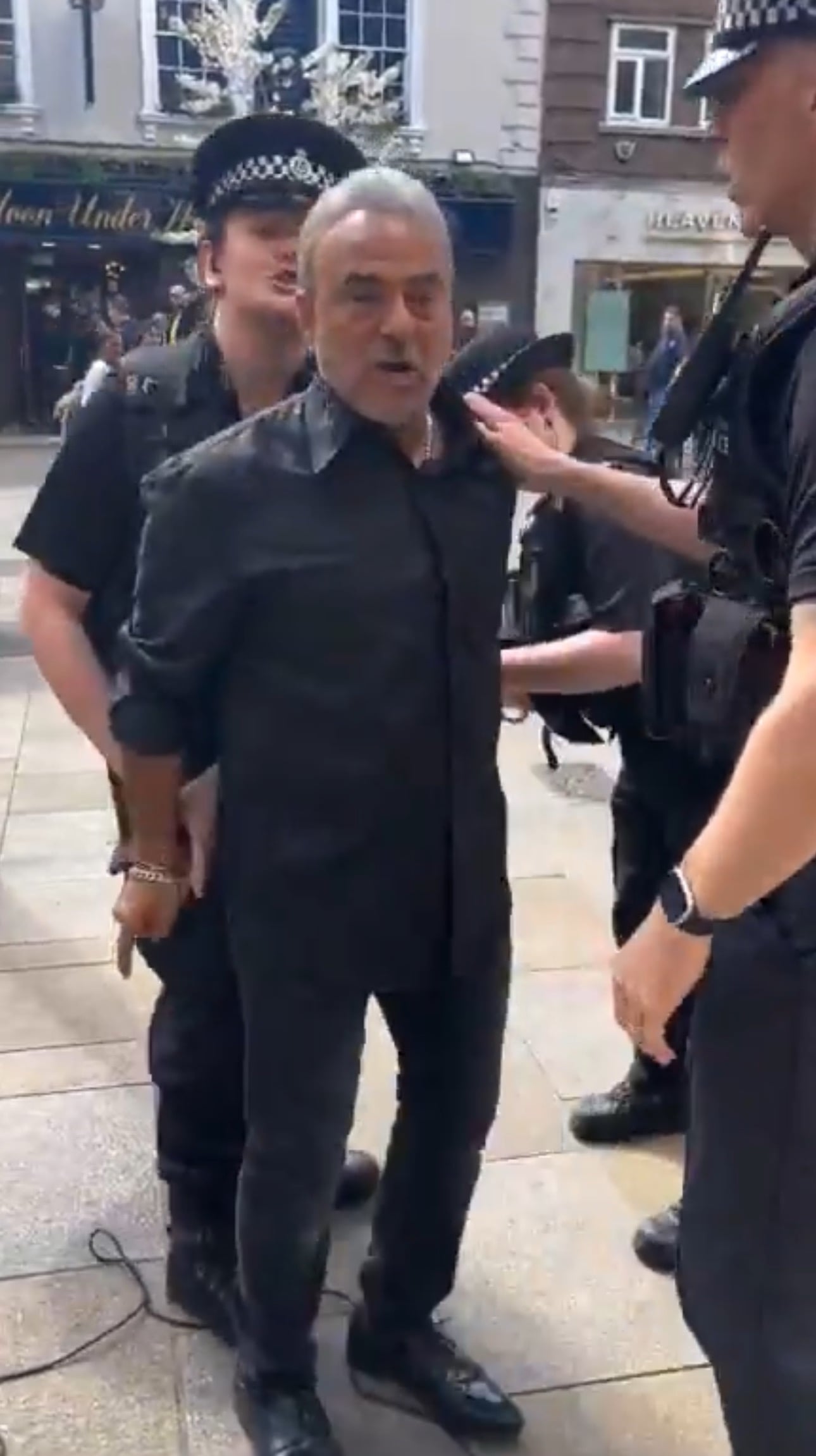
There is something deeply uncomfortable about watching a man in handcuffs, surrounded by police officers, continuing to preach the Gospel on a British street. Not because the scene is violent or threatening. But precisely because it is not. And yet it is happening — with alarming regularity.
Two cases in recent weeks have brought this issue into sharp focus. Britannia Daily exclusively revealed the arrest of Steve Maile, a senior pastor with more than 35 years of evangelical ministry, who was detained by police while preaching in a public street in front of his wife and children. Around the same time, Pastor Dia Moodley of Bristol found himself in a police cell for eight hours after a couple complained about his street preaching on transgender ideology and theological differences between Christianity and Islam. Both men deny any wrongdoing. Both are now awaiting the outcome of ongoing police investigations. Both have one more thing in common: they are Christians, preaching peacefully in public, in a country that still — on paper at least — guarantees freedom of religion and freedom of expression.
When Did Peaceful Preaching Become a Police Matter?
The law is not ambiguous on this point. Street preaching has been a feature of British public life for centuries. From John Wesley delivering sermons on village greens to the Salvation Army marching through town centres, the tradition of open-air religious expression is woven into the fabric of this country’s history. There is no law that prohibits it. And yet, in both the Maile and Moodley cases, police did not hesitate to move in.
In Maile’s case, Hertfordshire Police confirmed he was arrested on suspicion of assault and a Section 5 public order offence — specifically racially or religiously aggravated disorderly behaviour. He has denied all allegations. The assault allegation has since been dropped entirely. He was released on bail for three months.
In Moodley’s case, the sequence of events is even more troubling. Not only was he arrested for preaching — he was also physically assaulted on the same occasion, with one individual reportedly threatening to stab him. No charges were brought against any of his attackers. The man doing the preaching was criminalised. The man threatening violence walked free. If that does not constitute two-tier policing, it is difficult to know what would.
Public Order Law Is Being Stretched Beyond Recognition
The legal mechanism being used in both cases is the Public Order Act — legislation designed to prevent genuine disorder, harassment, and intimidation. It was never intended as a tool to silence religious speech that some members of the public find uncomfortable. Yet that is precisely how it is increasingly being deployed.
ADF International’s legal counsel Jeremiah Igunnubole put it plainly in response to the Moodley case. “Pastor Dia’s arrest for peacefully commenting on Islam and transgender ideology shows police are using public order legislation to impose de facto blasphemy laws in the UK,” he said. That is a serious charge — and one that deserves a serious answer from the authorities responsible.
Britain abolished its blasphemy laws in 2008. It did so because a free society cannot have the state acting as the arbiter of which religious ideas are permissible and which are not. The concern now is that what was removed through the front door is being quietly reintroduced through the back — not through legislation, but through selective enforcement of public order powers against speech that generates complaints.
The Pattern Is Too Consistent to Ignore
What makes these cases particularly difficult to dismiss as isolated incidents is their pattern. Moodley has faced repeated police intervention over several years. Officers once attempted to bar him from discussing any religion other than Christianity during his street outreach — a restriction later formally acknowledged as “disproportionate” only after he mounted a legal challenge. In other words, police imposed an unlawful restriction on a man’s religious expression, maintained it until he fought back legally, and then quietly dropped it. No accountability. No consequences.
Maile, meanwhile, described being “double handcuffed” and suffering “excruciating pain” during his arrest, carried out in front of his wife — who was visibly shaking — and children who were in tears. Whatever one thinks of evangelical street preaching, this is not a proportionate response to a man reciting scripture on a public pavement.
What This Says About Britain in 2026
There is a version of this story that defenders of the police will tell. They will say officers were responding to complaints. They will say the Public Order Act gives them the power to act. They will say these are operational decisions made in good faith in difficult circumstances.
All of that may be partially true. But it does not address the fundamental question at the heart of both cases: why is it that in modern Britain, a Christian preacher expressing orthodox theological views in a public space is treated as a threat to public order, while those who threaten and assault him are not?
Freedom of expression means very little if it only protects speech that nobody finds offensive. By definition, the speech that most needs protecting is precisely the speech that makes people uncomfortable. The moment police begin acting as enforcers of community sensitivities rather than upholders of the law equally applied, something essential about a free society begins to erode.
Britain has a proud tradition of religious tolerance and open public discourse. It would be a profound failure of that tradition if street preachers — men with Bibles, not weapons — become the defining symbol of where its limits now lie.
