


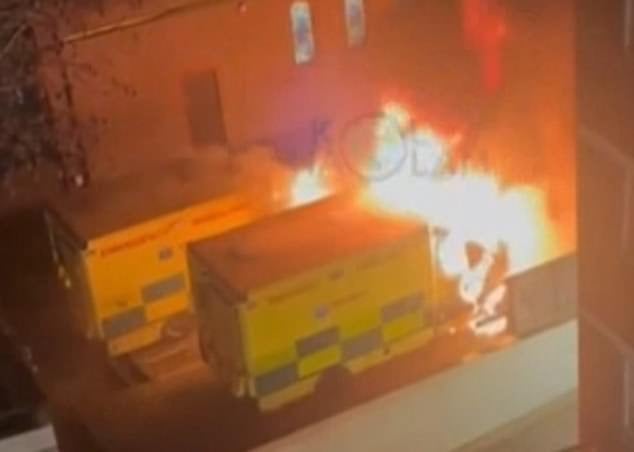
Counter Terrorism Police have made a third arrest in connection with an alleged arson attack on four Jewish community ambulances in northwest London, as prosecutors told a court there is “significant evidence” the incident represented a premeditated assault on the Jewish community. The development came as two men appeared at Westminster Magistrates’ Court charged with the attack, which saw volunteer emergency vehicles destroyed by fire and exploding gas canisters in Golders Green.
Hamza Iqbal, 20, and Rehan Khan, 19, both British nationals from Leyton, were remanded in custody following Saturday’s hearing, whilst a 17-year-old dual British and Pakistani national from Walthamstow appeared separately and was remanded into youth detention accommodation. The Crown Prosecution Service confirmed all three had been charged on Friday following the investigation into the early-morning attack on 23 March.
“Significant evidence of premeditation”
Prosecutor Emma Harraway announced the latest arrest during Saturday’s court proceedings, telling the hearing: “There is significant evidence that this was a premeditated and targeted attack against the Jewish community.” The statement marks the first official characterisation of the incident’s apparent motivation, though authorities have not classified the case as terrorism.
The attack targeted ambulances belonging to Hatzola, a volunteer-led emergency service operating in the heavily Jewish area of Golders Green. Four vehicles were set ablaze in the early hours, with gas canisters stored inside the ambulances exploding as the fires took hold. The destruction of emergency medical vehicles serving a specific religious community has heightened concerns about antisemitic violence during a period of elevated tensions.
The Golders Green attack and its aftermath
The arson took place during the early morning of 23 March, when unknown assailants set fire to four Hatzola ambulances parked in northwest London. The volunteer service provides emergency medical response specifically for the Jewish community in the Golders Green area, operating alongside the NHS ambulance service to ensure rapid assistance for local residents.
Gas canisters stored within the vehicles exploded as flames engulfed the ambulances, though no injuries were reported from the incident itself. The attack effectively removed critical emergency response capacity from a community-run service that relies on volunteer paramedics and donated equipment.
Counter Terrorism Policing assumed leadership of the investigation despite the case not being formally treated as terrorism. Commander Helen Flanagan, Head of Counter Terrorism Policing London, explained that “due to the circumstances of the incident”, CTP detectives would lead the inquiry whilst working alongside local policing teams.
By Friday, three individuals faced charges in connection with the attack. Hamza Iqbal and Rehan Khan, both in their late teens and early twenties, appeared at Westminster Magistrates’ Court on Saturday alongside the 17-year-old defendant, whose identity cannot be published due to his age. All three were remanded – the adults into custody and the youth into detention accommodation.
Two other men, aged 45 and 47, were arrested last week but released on bail until late April, indicating the investigation encompasses a potentially wider network than the three already charged.
Heightened security during Passover
The timing of the attack, coinciding with the approach of Passover, has intensified Jewish community anxiety about targeted violence. Detective Chief Superintendent Luke Williams, who leads policing in North West London, acknowledged these concerns in a statement following the court appearances.
“We know that local community concerns continue to remain high, particularly for our Jewish communities in the Passover festival period,” he said. The eight-day festival, one of Judaism’s most significant religious observances, typically sees increased attendance at synagogues and community gatherings, potentially creating additional security vulnerabilities.
In response, Metropolitan Police have implemented what DCS Williams described as “an enhanced, bespoke policing plan, which has been focused around vulnerable areas not only in Golders Green, but right across London.” The deployment involves “a significant number of additional officers on the ground, with the aim of protecting communities, disrupting offenders, and detecting crime.”
Notably, the security enhancement includes “highly visible armed police patrols to serve as a deterrent to anyone seeking to cause our communities harm,” an unusual measure for routine community policing that reflects the assessed threat level. Such deployments typically signal serious concern about potential violence rather than standard precautionary measures.
Counter Terrorism involvement without terrorism classification
The apparent contradiction of Counter Terrorism Police leading an investigation not classified as terrorism reflects the complexity of modern threat assessment. CTP increasingly handles cases where the target selection suggests ideological motivation but the specific offences do not meet legal definitions of terrorism requiring proof of political or religious aims designed to intimidate populations or compel governmental action.
The attack’s characteristics – premeditation, targeting of community infrastructure, symbolic value of destroying emergency vehicles serving a specific faith group – align with terrorism patterns whilst the actual criminal acts constitute arson and potentially hate crimes under existing law.
Commander Flanagan emphasised the investigation’s progress: “Since this appalling attack last week, we have been working continuously to investigate and identify those responsible. The investigation has now reached a stage where three people have been charged, and they will now appear in court.”
She also highlighted community cooperation: “I want to reiterate that the support we had from the local community since this attack took place has been incredible, and we will continue to work closely with local policing colleagues to do everything we can to keep the public safe.”
Britain’s Jewish communities and rising security concerns
The Golders Green attack occurs against a backdrop of documented increases in antisemitic incidents across Britain, with Jewish community organisations reporting elevated threat levels since the outbreak of conflict in the Middle East last year. Attacks on specifically Jewish infrastructure – synagogues, schools, community centres and now emergency services – represent a distinct escalation from verbal abuse or online harassment.
Hatzola services operate in several British cities with significant Jewish populations, providing volunteer emergency medical response that complements NHS provision whilst addressing specific community needs including religious observance considerations during treatment. The destruction of their vehicles therefore impacts both immediate emergency response capability and the broader sense of security within Jewish communities.
The nationality composition of those charged – British nationals and a dual British-Pakistani national – will likely feature in ongoing debates about domestic radicalisation and integration, though authorities have not publicly addressed potential motivations beyond the prosecutor’s statement about targeting the Jewish community.
What happens next in the legal process
The three charged individuals will proceed through the criminal justice system, with the case likely moving from magistrates’ court to crown court given the seriousness of the charges. The remand decisions indicate prosecutors and magistrates assessed significant flight risk or danger to the public in granting bail.
The two men released on bail pending further investigation face return dates in late April, suggesting ongoing evidence gathering that may result in additional charges or their release without further action. The scale of the investigation, involving Counter Terrorism Police resources and multiple arrests, indicates authorities are examining whether a broader network supported or encouraged the attack.
For the Golders Green community and Hatzola specifically, the immediate priority involves restoring emergency response capacity whilst the investigation continues. Whether insurance and fundraising can rapidly replace the destroyed ambulances will determine how long the service operates with reduced capability.
The enhanced policing presence during Passover provides short-term reassurance, though the sustainability of such deployments beyond immediate festival periods remains uncertain given Metropolitan Police resource constraints and competing demands across London.
Implications for faith community security across the UK
The attack raises uncomfortable questions about the security of faith-based institutions and services in contemporary Britain. Whilst government funding exists for protective security at synagogues and Jewish schools, volunteer community services like Hatzola have historically operated without comparable protection, their vehicle parking locations potentially vulnerable to determined attackers.
Similar considerations apply to Muslim community centres, Sikh gurdwaras and other faith-based facilities that serve specific populations. The precedent of targeting emergency medical services represents a particularly concerning development, as it undermines community resilience and potentially deters volunteer participation in essential services.
British authorities have long grappled with balancing visible security measures against normalising the presence of armed police and physical barriers around places of worship. The Golders Green response, including armed patrols, suggests officials believe the threat level justifies extraordinary measures even at the cost of community unease about militarised policing.
The prosecutor’s statement about premeditation and targeting also carries implications for hate crime legislation and sentencing. If proven, such evidence would likely trigger enhanced sentences under provisions treating attacks motivated by religious hatred more severely than ordinary criminal damage.
Key Facts and Background
Who has been charged in connection with the attack?
Hamza Iqbal, 20, and Rehan Khan, 19, both British nationals from Leyton, have been charged and remanded in custody. A 17-year-old dual British and Pakistani national from Walthamstow has also been charged and remanded into youth detention. A third arrest was announced on Saturday.
What is Hatzola?
Hatzola is a volunteer-led ambulance service operating in areas with significant Jewish populations, including Golders Green in northwest London. It provides emergency medical response specifically for the Jewish community whilst working alongside NHS ambulance services.
When did the attack occur?
The arson attack took place in the early hours of 23 March, when four Hatzola ambulances were set on fire, causing gas canisters stored in the vehicles to explode.
Is this being treated as terrorism?
No. Despite Counter Terrorism Police leading the investigation due to “the circumstances of the incident”, the case is not currently classified as terrorism.
What additional security measures have been implemented?
Metropolitan Police have deployed a significant number of additional officers in vulnerable areas across London, including specialist officers and highly visible armed police patrols, particularly during the Passover festival period.
What happened to the other two arrested men?
Two men aged 45 and 47, both British nationals arrested last week, were released on bail until late April pending further investigation.
