


Religious authorities across denominations mounted an unprecedented Easter challenge to the ongoing Middle East conflict, with one of America’s most conservative bishops publicly declaring that Pentagon justifications for the Iran campaign fail fundamental Christian ethical standards whilst Britain’s newly installed Archbishop delivered her first major sermon calling for an immediate end to Gulf violence.
Archbishop Timothy Broglio, appointed by Pope Benedict XVI and known for his traditionally hawkish positions, told CBS News that US Defense Secretary Pete Hegseth’s invocation of Jesus Christ to justify military operations was “problematic” and that American strikes do not meet the criteria established by Saint Augustine’s just war doctrine—a theological framework that has governed Christian thinking on legitimate warfare for 1,600 years.
The intervention marks a significant departure from Broglio’s typically conservative stance and signals growing unease within the Catholic hierarchy about the administration’s framing of the conflict in religious terms. His critique centres on the administration’s reliance on Iran’s alleged nuclear weapons programme as justification for military action—a threat Broglio noted does not actually exist, as Tehran possesses no such arsenal.
“The theory says war is only morally permissible when punishing wrongdoing or defending the innocent and always with the ultimate aim of restoring peace rather than for revenge or conquest,” the Archbishop explained, dismantling the administration’s case against Augustinian principles that require proportionality, legitimate authority, and just cause.
What Britain’s New Archbishop Said in Her Inaugural Easter Appeal
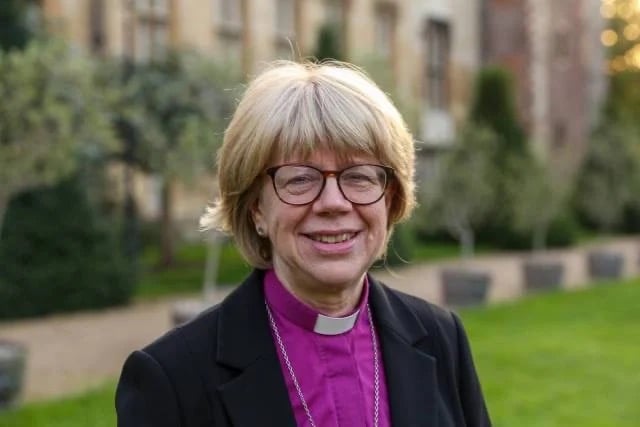
The theological pushback extended to Canterbury Cathedral, where Most Reverend Dame Sarah Mullally—installed as the 106th Archbishop of Canterbury less than a fortnight ago—used her first Easter Day sermon to issue an urgent call for prayers to end “violence and destruction in the Middle East and the Gulf.”
Dame Sarah, a former chief nursing officer for England whose elevation represented a historic break with tradition, told her congregation that “violence, division and insecurity are affecting the lives of billions of people around the world” and that “many feel that their heart is in pieces.”
Her remarks carried particular weight given their timing. Speaking as the conflict entered its second month following the 28 February strikes that killed Ayatollah Ali Khamenei, the Archbishop directly addressed “the bereft, the wounded, the refugee” whilst calling on worshippers to direct their “gaze and prayers” towards “the land where Jesus was crucified and raised from the dead.”
“Today, as we shout with joy that Christ is risen, let us pray and call with renewed urgency for an end to the violence and destruction in the Middle East and the Gulf,” Dame Sarah declared. “May our Christian sisters and brothers know and celebrate the hope of the empty tomb—and may all people of the region receive the peace, justice and freedom they long for.”
The sermon represented a careful calibration of moral authority and diplomatic sensitivity, avoiding explicit criticism of any party whilst making clear Canterbury’s position that the human cost has become intolerable. Her reference to Christian communities in the region acknowledged the particular vulnerability of religious minorities caught between warring powers.
Why Augustine’s Doctrine Now Challenges Pentagon Strategy
Archbishop Broglio’s application of just war theory to the Iran conflict exposes fundamental tensions in how the administration has justified its military campaign. The Augustinian framework, developed in the fourth and fifth centuries and refined by Thomas Aquinas in the medieval period, establishes rigorous tests that must be met before Christian nations can legitimately wage war.
Central to the doctrine is the requirement that military action must respond to actual rather than hypothetical threats. The Archbishop’s observation that Iran possesses no nuclear weapons directly undermines Secretary Hegseth’s public justifications, which have repeatedly cited the need to prevent Tehran from acquiring such capabilities.
The just war tradition also demands that force be employed only when all reasonable alternatives have been exhausted and that military operations aim ultimately at establishing sustainable peace rather than achieving dominance or exacting vengeance. Broglio’s characterisation of Hegseth’s religious rhetoric as “problematic” suggests concern that the administration has instrumentalised Christian language to sanctify operations that fail these ethical tests.
The critique gains additional significance from its source. Broglio’s conservative credentials and historical reluctance to challenge Republican administrations make his Easter Sunday intervention all the more striking, indicating that concern about the conflict has penetrated even traditionally supportive quarters of the American Catholic establishment.
The Growing Religious Resistance to Military Escalation
Dame Sarah’s Easter appeal forms part of a coordinated religious response that transcended denominational boundaries on Sunday. Pope Leo XIV, delivering the Urbi et Orbi blessing in Rome, issued his own challenge to political leaders without naming specific conflicts.
“Let those who have weapons lay them down,” the pontiff declared, warning that the world was “growing accustomed to violence, resigning ourselves to it and becoming indifferent.” His appeal to “those who have the power to unleash wars” to “choose peace” echoed the Archbishop of Canterbury’s call whilst employing more direct language about the normalisation of mass violence.
The Pope had characterised the conflict as “atrocious” during Palm Sunday observances the previous week, establishing a consistent Vatican position throughout Holy Week that culminated in Easter’s coordinated messaging across Catholic and Anglican leadership.
Dame Sarah’s October address as Archbishop-designate had foreshadowed her Easter intervention, expressing her desire for the “life-changing hope” of Jesus Christ to reach those affected by war and extreme poverty. She had specifically named Palestinian Christians alongside “all the peoples of the Middle East” as well as populations in Ukraine, Russia, Sudan, Myanmar and the Democratic Republic of Congo, praying that “God end the horrors of war, comfort those who mourn, and bring hope to those living in despair.”
Her reference to being on “the front lines of the ever-worsening climate crisis” during that earlier speech suggested an Archbishop prepared to engage forcefully with contemporary policy challenges, a promise fulfilled by Sunday’s direct intervention on the Gulf conflict.
Canterbury’s Voice Carries Weight in British Foreign Policy Debate
For the United Kingdom, the Archbishop of Canterbury’s public positioning on the Iran war carries implications beyond spiritual leadership. As titular head of the worldwide Anglican Communion and a member of the House of Lords, Dame Sarah’s statements inevitably influence domestic debate about Britain’s relationship with American military operations and its broader Middle East policy.
Her calculated reference to “Christian sisters and brothers” in the region acknowledges London’s historical role as protector of Christian minorities whilst avoiding explicit criticism of Washington’s conduct. The formulation allows the Archbishop to express solidarity with vulnerable populations without directly challenging the transatlantic alliance—a delicate balance that reflects both theological conviction and diplomatic awareness.
The timing of her inaugural Easter sermon, delivered whilst she remains relatively new to the role, establishes early parameters for Canterbury’s engagement with foreign policy questions during her tenure. That she chose to make the Middle East conflict a centrepiece of her first major liturgical address signals an Archbishop unwilling to retreat into purely domestic concerns.
Dame Sarah’s background as chief nursing officer for England—a role requiring navigation of complex bureaucratic and political relationships—may inform her approach to contentious international issues. Her acknowledgment during her installation that her teenage self “could never have imagined the future that lay ahead” suggested awareness that her elevation represented an opportunity to reshape how religious authority engages with contemporary crises.
As Iran and the United States continue exchanging military strikes whilst Tehran maintains its blockade of the Strait of Hormuz, the coordinated Easter appeals from Canterbury, Rome, and conservative American prelates indicate that religious opposition to the conflict’s continuation has solidified across traditional theological and political divides. Whether such moral pressure can influence strategic calculations in Washington or Tehran remains uncertain, but the rare unity of religious voices—from progressive Anglican leadership to conservative Catholic bishops—suggests the humanitarian cost has begun to override institutional reluctance to challenge state power directly.
