

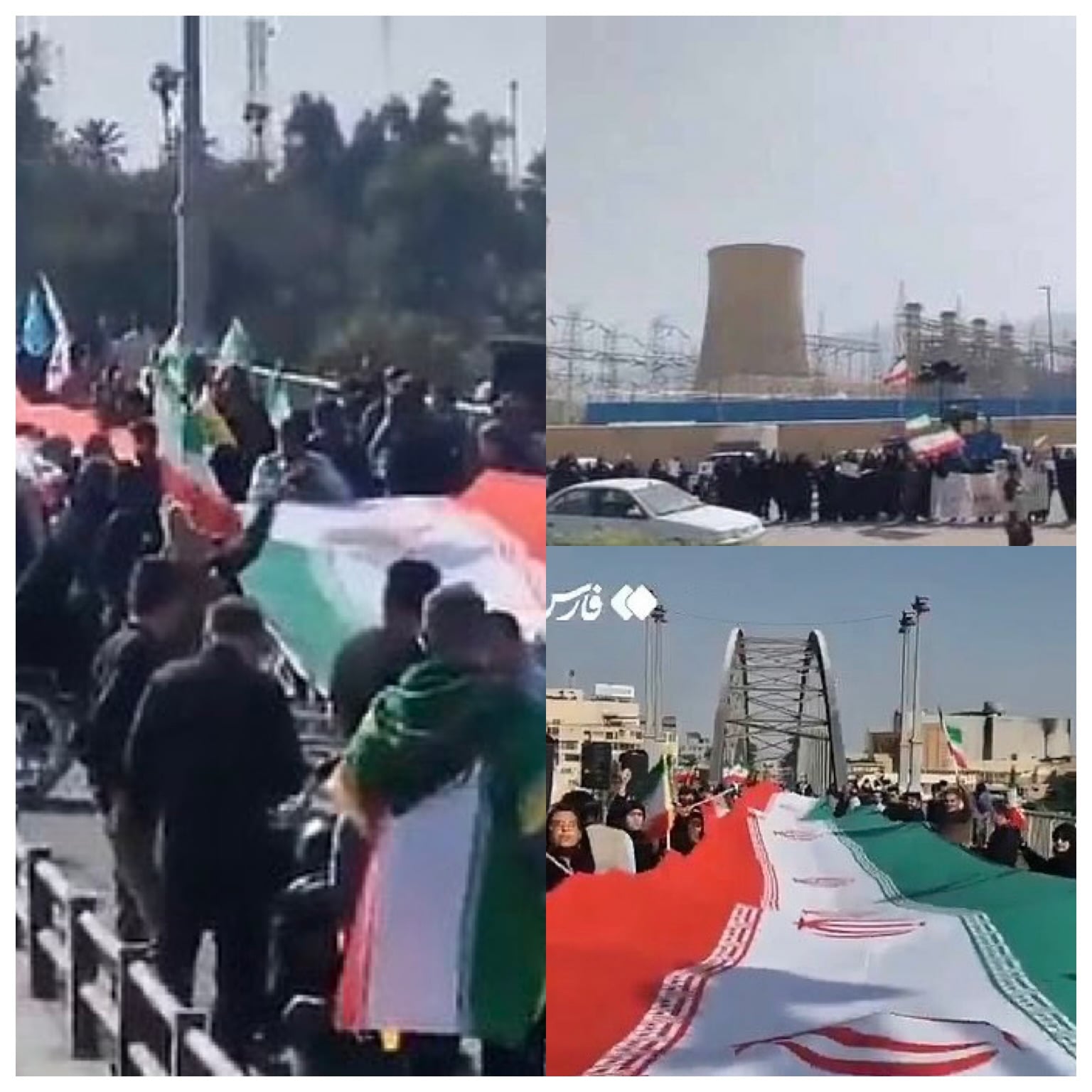
Iranian state television broadcast extraordinary scenes Tuesday of women and children massed at bridges and power plants across the Islamic Republic—a calculated gambit positioning civilians as human shields against threatened American strikes whilst simultaneously severing direct diplomatic communications with Washington hours before President Donald Trump’s 8pm Eastern Time ultimatum expires.
The dual strategy of communication shutdown and civilian deployment represents Tehran’s starkest acknowledgment yet that it will not reopen the Strait of Hormuz under deadline pressure, whilst attempting to impose moral and legal constraints on American targeting through images of flag-waving families at infrastructure sites Mr Trump has vowed to obliterate. Video footage showed women and children chanting as loudspeakers blared defiant slogans—a direct taunt designed to confront the President with unambiguous choice between postponing his deadline or authorising strikes that would inevitably produce mass civilian casualties.
The communication severing, confirmed by The Wall Street Journal, leaves Pakistan-mediated indirect negotiations as the sole remaining diplomatic channel as the clock advances toward evening confrontation. An Iranian official characterised the cutoff as deliberate message of “defiance and disapproval” rather than breakdown in protocol—a calculated escalation designed to demonstrate that Tehran will not capitulate regardless of American military superiority or apocalyptic rhetoric.
Yet extraordinary intelligence suggesting Iran’s nominal supreme leader Ayatollah Mojtaba Khamenei lies unconscious and “unable to be involved in any decision-making” raises profound questions about who actually authorised the communication severance and civilian shield deployment. A fresh intelligence memo shared among Western governments indicates the son of assassinated leader Ali Khamenei—killed during 28 February US-Israeli strikes—cannot participate in the existential decisions facing his nation at its moment of gravest peril.
What Civilian Shield Deployment Reveals About Tehran’s Calculation
The decision to position non-combatants at threatened infrastructure sites represents desperate gamble that international humanitarian law constraints and domestic American political pressure will prove more powerful than Mr Trump’s stated willingness to annihilate Iranian civilisation. By broadcasting the deployments via state television, Iranian authorities ensure that any strike on bridges or power plants will produce documented civilian casualties impossible to characterise as collateral damage or targeting error.
The strategy exploits fundamental tension in American threats: Mr Trump’s Monday declaration that “very little is off limits” and promises that “every power plant will be destroyed, every bridge” constitute explicit targeting of civilian infrastructure—conduct that legal experts universally characterise as potential war crimes under Geneva Convention protections. Iranian authorities calculate that confronting American forces with deliberate choice between abandoning stated objectives or committing documented atrocities may introduce hesitation absent from purely military targeting decisions.
Yet the gambit carries extraordinary risks for Iranian civilians volunteering or compelled to serve as shields. If American forces proceed with threatened strikes despite visible civilian presence, participants face death or maiming whilst providing Tehran with propaganda victory purchased through their sacrifice. If strikes are postponed or cancelled, the shield deployment achieves immediate tactical success whilst establishing precedent encouraging future civilian positioning at military or dual-use facilities.
The loudspeaker chanting and flag-waving captured in broadcast footage suggests orchestrated demonstration rather than spontaneous civilian mobilisation—state direction positioning participants for maximum visual impact whilst ensuring international media captures imagery designed to complicate American decision-making. Whether participants volunteered through patriotic motivation, faced social pressure within local communities, or received explicit direction from security services remains unclear from available reporting.
Children’s prominent presence in broadcast imagery represents particularly calculated element, positioning the most sympathetic victims in direct line of threatened American munitions. International humanitarian law provides special protections for children in armed conflict, making their deliberate exposure to imminent attack a potential violation by Iranian authorities even as it creates compelling argument against American strikes proceeding as planned.
Steve Witkoff, Mr Trump’s special envoy, and Vice President JD Vance have engaged extensively in negotiations mediated through Pakistani channels—the sole remaining diplomatic architecture following direct communication severance. Pakistan’s intermediary role reflects its unique position maintaining relationships with both Washington and Tehran whilst possessing credibility neither party extends to traditional Western allies or Gulf Arab states whose regional interests create perception of bias.
Why Leadership Incapacitation Creates Ungoverned Crisis
The intelligence assessment that Mojtaba Khamenei cannot participate in decision-making transforms understanding of Iranian crisis management. Supreme Leader designation carries ultimate authority over strategic decisions including war continuation, negotiating positions and responses to existential threats. His incapacitation leaves unclear who exercises that authority during the Islamic Republic’s gravest external crisis since the 1980s Iran-Iraq War.
Iranian governance structures include multiple power centres—the elected presidency, Guardian Council, Assembly of Experts, and Islamic Revolutionary Guard Corps—whose relationships involve complex negotiation and consensus-building even when supreme leadership provides clear direction. Absent that direction, decision-making could fracture across competing factions pursuing divergent strategies based on distinct threat assessments and risk tolerances.
The communication severance decision and civilian shield deployment suggest hardline elements currently dominate Iranian crisis response, prioritising defiance over compromise regardless of catastrophic risk. Yet whether these decisions reflect genuine consensus among Iran’s fractured leadership or initiatives by specific factions exploiting power vacuum remains unknowable from external observation.
Mr Trump’s assertion that “now that we have Complete and Total Regime Change, where different, smarter, and less radicalized minds prevail, maybe something revolutionarily wonderful can happen” appears disconnected from reported reality that Iran’s new nominal leader cannot participate in governance. The claim of “regime change” enabling different decision-making assumes functional leadership succession—precisely what available intelligence suggests has not occurred.
The overnight Kharg Island strikes targeting approximately 50 military installations—bunkers, radar stations and ammunition storage—represent measured escalation focused on degrading Iranian military capability rather than implementing threatened comprehensive infrastructure destruction. Senior administration officials confirmed the operation whilst declining to characterise it as either prelude to broader civilian targeting or substitute demonstrating American capability without triggering promised apocalypse.
Footage circulating on social media documented destruction’s aftermath on the strategically vital oil export hub, though independent verification remained impossible given access restrictions and ongoing combat operations. Growing speculation about potential American ground invasion to permanently seize Kharg Island reflects recognition that aerial bombardment alone cannot reopen the Strait of Hormuz if Iranian leadership—however constituted—maintains closure determination.
Senior Iranian officials’ rejection of temporary ceasefire proposals conveyed through intermediaries, reported by Reuters, establishes that even indirect negotiations have failed to identify mutually acceptable off-ramp from escalatory spiral. Tehran shows no indication of reopening the strait through which 20 to 25 percent of global seaborne oil transits—the passageway whose closure precipitated current crisis and whose reopening Mr Trump established as non-negotiable deadline condition.
The President’s Truth Social declaration that “a whole civilization will die tonight, never to be brought back again” followed by qualification “I don’t want that to happen, but it probably will” maintains pattern of apocalyptic rhetoric accompanied by operational flexibility that has characterised the campaign. His invocation of divine blessing—”God Bless the Great People of Iran!”—attempts to distinguish Iranian population from their government whilst threatening comprehensive societal destruction.
Whether evening brings promised annihilation, extended deadline, or negotiated resolution remains unknowable hours before expiration. What stands established is that Tehran has chosen confrontation over capitulation, positioning civilians at threatened sites whilst severing direct communication channels, all whilst nominal leadership lies incapacitated and unable to participate in decisions that will determine whether the Islamic Republic survives the night intact or faces devastation unprecedented in modern warfare. Pakistan’s mediators face impossible task of bridging positions where one party threatens civilisational extinction and the other deploys human shields whilst refusing dialogue—circumstances where rational negotiation yields to watching clocks advance toward arbitrary deadlines that may herald everything or nothing.
