


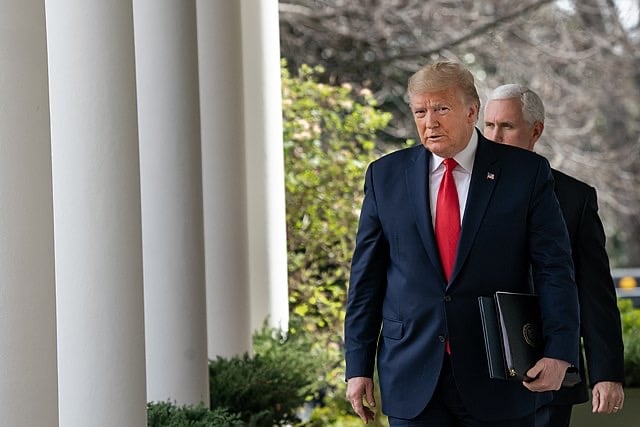
The apocalyptic and the mundane collided Tuesday morning when President Donald Trump warned that Iran’s “whole civilization will die tonight” mere hours after American forces conducted precisely targeted strikes against 50 military installations on Kharg Island—an operation that destroyed bunkers, radar stations and ammunition depots whilst carefully avoiding the very civilian infrastructure Mr Trump has repeatedly threatened to obliterate.
The disconnect between existential rhetoric and calibrated military action crystallises the fundamental ambiguity plaguing the Iran campaign: whether Tuesday’s 8pm Eastern Time deadline represents genuine inflection point toward comprehensive destruction, or the latest iteration of postponed ultimatums that have transformed military brinkmanship into economic warfare causing America’s gasoline prices to surge past $4.14 per gallon whilst global markets remain paralysed by strategic uncertainty.
“A whole civilization will die tonight, never to be brought back again,” Mr Trump declared on Truth Social, employing language suggesting total war against Iranian society. “I don’t want that to happen, but it probably will.” Yet the overnight Kharg Island operation—significant in targeting Iran’s crucial oil export hub—struck military capabilities rather than the bridges and power plants the President has vowed to destroy if Tehran refuses to reopen the Strait of Hormuz by day’s end.
Senior Iranian officials had already rejected ceasefire proposals conveyed through intermediaries, according to Reuters, whilst Iran’s UN envoy characterised Tuesday’s deadline as “direct incitement to terrorism” providing “clear evidence of intent to commit war crimes.” The regime’s military command dismissed Mr Trump as “delusional,” establishing diplomatic impasse that left investors unable to calculate whether the Commander-in-Chief would fulfil civilisational extinction threats or extend his deadline for the fourth time in three weeks.
Why Intelligence About Iran’s Incapacitated Leader Compounds Strategic Uncertainty
Extraordinary intelligence suggesting Iran’s new supreme leader Mojtaba Khamenei lies unconscious in the sacred city of Qom—87 miles south of Tehran—receiving treatment for severe medical conditions adds wild card to already volatile calculations about who exercises ultimate authority within Iranian decision-making structures as existential deadlines approach.
American and Israeli intelligence assessments shared with Gulf allies through diplomatic channels indicate Khamenei’s son is “not currently capable of running the regime,” raising profound questions about command coherence during the Islamic Republic’s gravest external crisis. Whether leadership incapacitation creates vulnerability enabling capitulation or hardens resistance by eliminating moderating voices depends on internal power dynamics inaccessible to external observers.
The timing of the intelligence revelation—emerging amid escalating military pressure hours before Mr Trump’s stated deadline—could reflect genuine collection success or information warfare designed to sow confusion about Iranian command authority and decision-making capacity. Either interpretation carries implications: if authentic, it suggests regime fragility precisely when facing comprehensive destruction threats; if manufactured, it represents psychological operation attempting to undermine Iranian domestic confidence in leadership continuity.
Vice President JD Vance’s assertion during a Budapest press conference that “very shortly, this war will conclude” and America has “largely accomplished its military objectives” contradicts the President’s apocalyptic framing whilst revealing internal administration divisions over both strategy and success metrics. “I’m hopeful that it gets to a good resolution,” Vance told reporters alongside Hungarian Prime Minister Viktor Orbán, noting that “more negotiations are expected” before the deadline—a formulation positioning diplomacy as primary track rather than prelude to promised annihilation.
The gulf between Vance’s measured optimism and Trump’s civilisational extinction warnings exposes either deliberate good cop/bad cop negotiating strategy or genuine disagreement about appropriate force employment and achievable objectives. For markets attempting to price catastrophic risk, the divergence offers no clarity—merely additional variables in already impossible calculation.
What Kharg Island Strikes Reveal About Actual Targeting Priorities
The overnight assault on Kharg Island represents the most significant operation yet against Iranian oil export infrastructure, targeting the facility through which substantial petroleum exports transit. Footage circulating on social media documented destruction’s aftermath, showing damaged military installations on the strategically vital island whilst avoiding the wholesale infrastructure devastation Mr Trump has repeatedly threatened.
Bunkers, radar systems and ammunition storage bore the brunt of American airstrikes, according to senior administration officials who confirmed the operation whilst declining to characterise it as either comprehensive campaign’s opening salvo or standalone demonstration of capability. The precision suggests military planners maintain targeting discipline focused on degrading Iranian military capacity rather than implementing promised bridge and power plant annihilation that would constitute potential war crimes under international humanitarian law.
Growing speculation about potential ground invasion to permanently seize Kharg Island reflects recognition that aerial bombardment alone cannot reopen the Strait of Hormuz if Iran maintains closure determination. Capturing the facility would require amphibious or airborne assault against defended positions—an operation exponentially more complex and casualty-intensive than aerial strikes, raising questions about whether such planning exists beyond speculative commentary or represents genuine operational consideration.
Iran’s threatened retaliation—bombing water desalination facilities serving American Gulf allies—exposes regional vulnerabilities complicating straightforward military victory narratives. Gulf cities surrounded by desert terrain depend absolutely on desalination plants for freshwater supplies, creating symmetrical vulnerability: American strikes on Iranian civilian infrastructure invite reciprocal attacks on infrastructure equally essential to survival in allied nations.
Monday’s White House press conference saw Mr Trump declare that “very little is off limits” whilst vowing “every power plant will be destroyed, every bridge”—comprehensive targeting that would constitute systematic attack on civilian infrastructure inconsistent with proportionality requirements under laws of armed conflict. Yet actual military operations through Tuesday morning have maintained focus on military capabilities rather than implementing threatened civilian infrastructure campaign.
The International Energy Agency’s warning that the conflict has triggered “the world’s biggest ever disruption to energy supplies” captures economic consequences of strategic uncertainty. Global oil markets remain largely frozen as investors prove unwilling to commit capital without clarity on whether apocalyptic threats represent genuine planning or negotiating posture subject to indefinite postponement.
American consumers experience this uncertainty directly through gasoline prices that have increased over one dollar per gallon since conflict onset, translating geopolitical brinkmanship into household budget pressure. Yet even these tangible costs pale beside potential consequences of comprehensive infrastructure destruction that would devastate Iranian civilian population whilst triggering retaliatory cascade across the region.
Mr Trump’s pattern of establishing and extending deadlines—having previously threatened to return Iran to the “stone age” before postponing action—has trained both adversaries and allies to view American ultimatums as negotiable rather than absolute. This credibility erosion creates perverse dynamic: markets must price catastrophic outcomes as genuine possibilities, generating real economic disruption, whilst Iran calculates that defiance carries lower political costs than capitulation given demonstrated American willingness to extend timelines.
The President’s Tuesday morning declaration concluded with theological invocation distinguishing Iranian population from their government: “God Bless the Great People of Iran!” The formulation attempts to position potential comprehensive destruction as liberation from corrupt leadership rather than punishment of civilian society—rhetorical framing that has historically accompanied interventions generating consequences far exceeding initial architectural ambitions.
Whether evening brings promised civilisational annihilation, extended deadline, or negotiated resolution remains unknowable hours before expiration. What stands established is the yawning gap between apocalyptic rhetoric and measured military action, between presidential threats and vice-presidential diplomacy, between promised comprehensive destruction and actual precision strikes—contradictions that leave markets, allies, and adversaries alike unable to calculate American intentions from American declarations. In such circumstances, Tuesday’s deadline may signify everything or nothing, depending on decisions not yet made by leaders operating under pressures that defy rational calculation.
